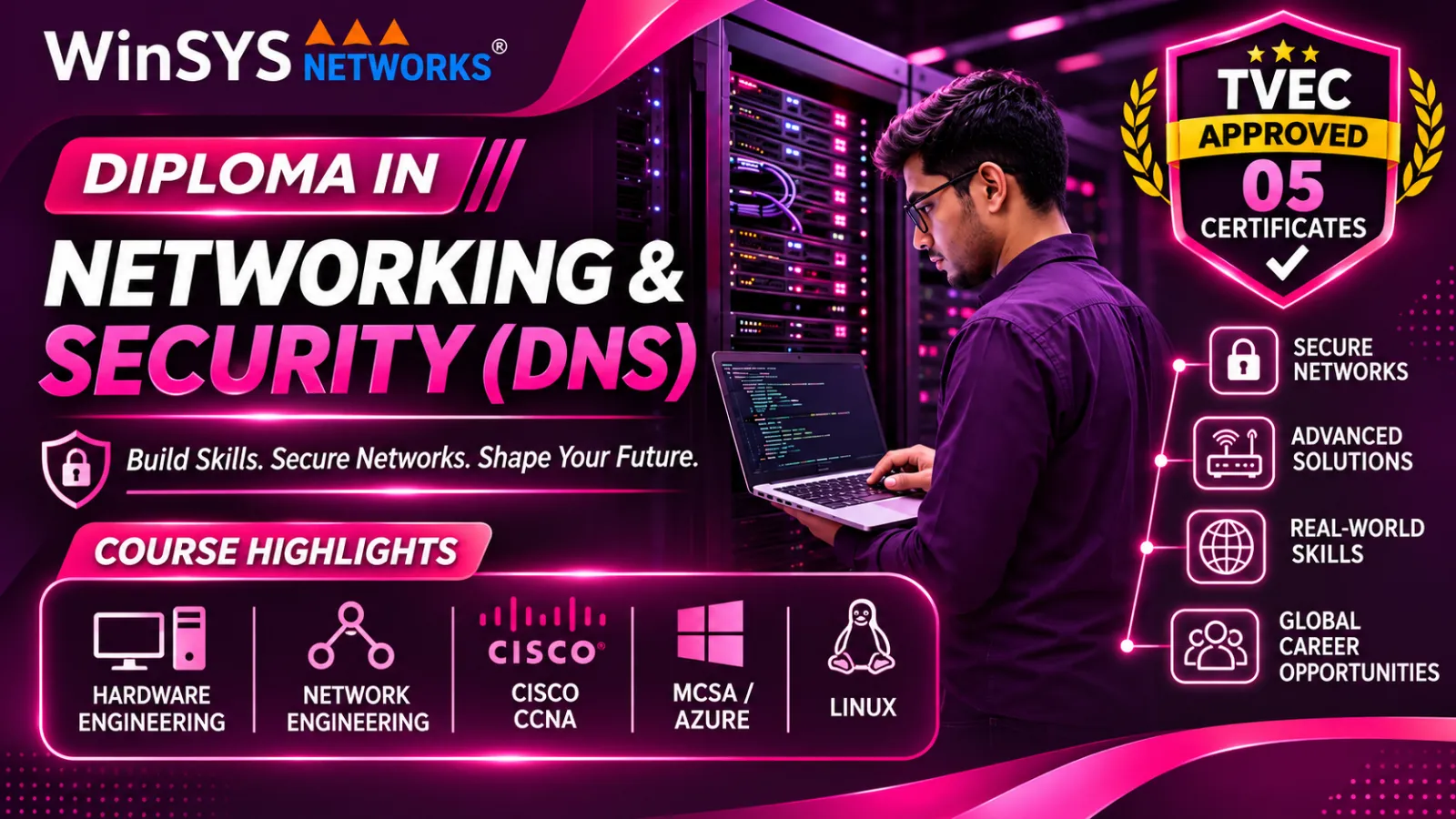
The Diploma in Network Security is designed to provide students with comprehensive theoretical knowledge and practical skills in computer hardware, network administration, Cisco networking, cloud computing, and Linux system administration.
This programme consists of five professional training areas, enabling students to develop a strong foundation in modern IT infrastructure and network security. Students will gain practical knowledge in computer hardware installation, assembling and troubleshooting, Windows Server administration, Cisco network configuration, Microsoft Azure cloud fundamentals, and advanced Linux system administration.
Throughout the programme, students will learn to configure and maintain computer systems, manage Windows-based network environments, implement Cisco networking technologies, understand cloud infrastructure, administer Linux servers, and apply essential network security practices.
The course emphasises hands-on practical training, laboratory exercises, system configuration, and real-world IT troubleshooting activities to develop industry-relevant technical competencies.
Upon successful completion, students will be equipped with the knowledge and practical skills required to pursue career opportunities in IT support, network administration, Windows Server administration, cloud computing, and Linux system administration, while providing a foundation for further professional studies and certifications.
Learning outcomes
Computer Hardware – Hardware EngineeringModule Learning Outcomes:
Upon successful completion of this module, students will be able to:
Identify computer hardware components and their functions.
Assemble and disassemble desktop computer systems.
Upgrade computer hardware components.
Install and configure operating systems.
Install and manage software, drivers, and applications.
Diagnose and troubleshoot hardware and software problems.
Perform preventive computer maintenance.
Configure basic computer networking and peripheral devices.
Windows Network – Windows Server AdministrationModule Learning Outcomes:
Upon successful completion of this module, students will be able to:
Understand computer networking fundamentals and network topologies.
Install and configure Windows Server.
Configure TCP/IP networking.
Install and manage DHCP and DNS services.
Configure Active Directory Domain Services (AD DS).
Manage users, groups, and network permissions.
Configure Windows Deployment Services (WDS).
Manage disk storage and network resources.
Configure file and printer sharing.
Implement basic network security and firewall configurations.
Configure and manage virtual environments using VMware.
Cisco CCNA – Cisco Certified Network Associate (200-301)Module Learning Outcomes:
Upon successful completion of this module, students will be able to:
Explain fundamental networking concepts and architectures.
Configure IPv4 and IPv6 addressing and subnetting.
Understand and configure VLANs and trunking.
Configure and troubleshoot Cisco switches.
Implement EtherChannel and Spanning Tree Protocol.
Configure static routing and OSPF.
Understand and implement IP services such as DHCP, DNS, and NAT.
Configure wireless networking fundamentals.
Apply network security and access control concepts.
Troubleshoot common network connectivity issues.
Microsoft Azure – Azure Fundamentals (AZ-900)Module Learning Outcomes:
Upon successful completion of this module, students will be able to:
Explain cloud computing concepts and service models.
Differentiate between public, private, and hybrid cloud environments.
Understand Microsoft Azure architecture and infrastructure.
Identify Azure compute, networking, and storage services.
Understand Azure subscriptions and resource groups.
Explain cloud security and identity management.
Understand Microsoft Entra ID and access management.
Identify Azure cost management and pricing tools.
Understand cloud governance, compliance, and monitoring.
Describe the benefits and applications of Microsoft Azure services.
Linux Advanced Administration
Module Learning Outcomes:
Upon successful completion of this module, students will be able to:
Install and configure Linux operating systems.
Use Linux command-line tools and administrative utilities.
Manage Linux users, groups, and permissions.
Configure and manage Linux system services.
Perform software and package management.
Understand and troubleshoot the Linux boot process.
Develop Bash shell scripts to automate administrative tasks.
Configure Linux networking and system connectivity.
Implement automated Linux installations and PXE deployment.
Monitor, troubleshoot, and optimise Linux system performance.
Upon successful completion, students will be able to:Assemble, upgrade, maintain, and troubleshoot computer hardware.
Install and configure Windows operating systems and Windows Server environments.
Manage network services, including DHCP, DNS and Active Directory.
Configure and troubleshoot Cisco routers and switches.
Understand IPv4, IPv6, VLANs, routing and network connectivity.
Understand Microsoft Azure cloud computing and infrastructure services.
Manage Azure resources and cloud fundamentals.
Install, configure and administer Linux operating systems.
Manage Linux users, groups, permissions and system services.
Apply basic network security and infrastructure protection practices.
Identify and troubleshoot common IT and networking problems.
Eligibility & entry requirements
Entry Requirements – Diploma in Network Security
Applicants should have successfully completed the G.C.E. Ordinary Level (O/L) examination or an equivalent qualification.
Basic computer literacy and familiarity with using computers.
Basic understanding of computer hardware and operating systems is an advantage.
An interest in computer networking, information technology, cloud computing, and network security.
Basic knowledge of mathematics and logical thinking is beneficial.
Ability to understand technical instructions and participate in practical laboratory sessions.
No previous professional IT experience is compulsory. Beginners, school leavers, IT students, and individuals interested in developing professional networking and IT infrastructure skills are welcome to apply.
🚀 Your career pathway
Where the Networking route can take you — from here to a degree and a career.
Possible career roles
🌍 Opportunities in: Sri Lanka · UK · Middle East